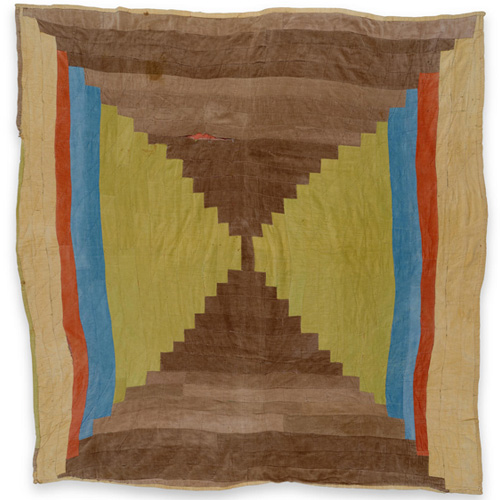
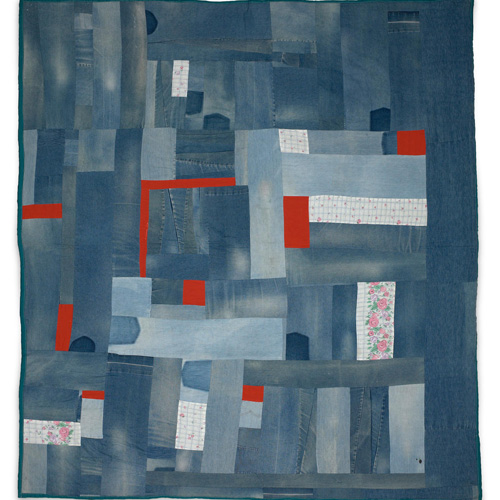
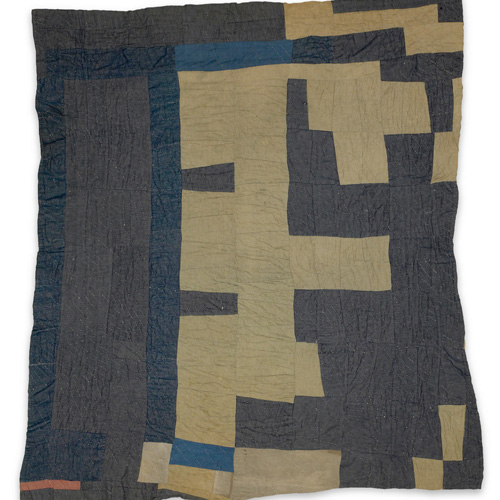
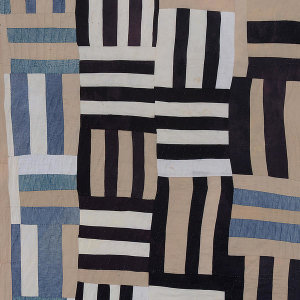
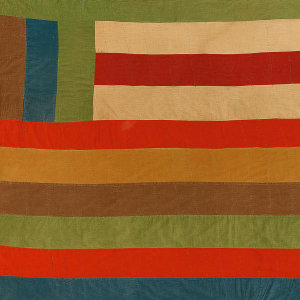
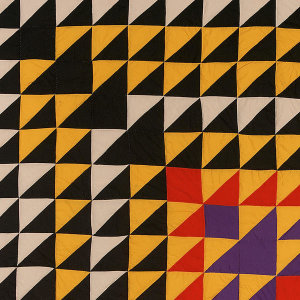
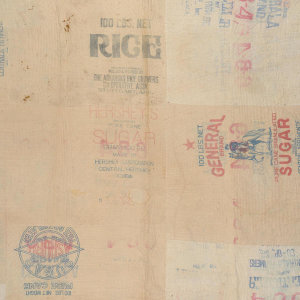
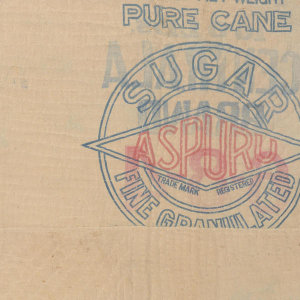
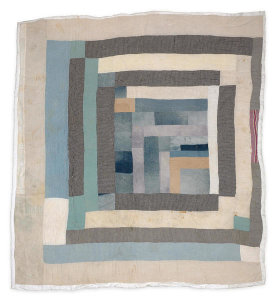
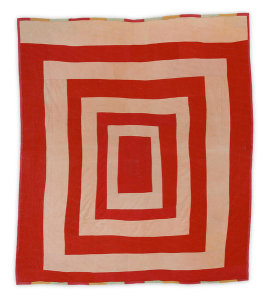
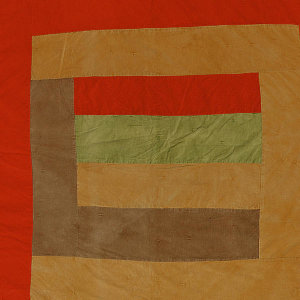
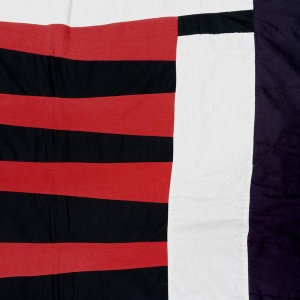
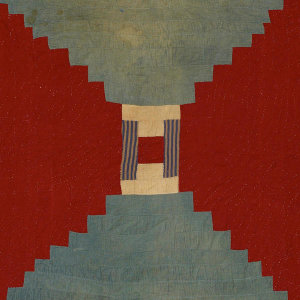
Rachel Carey George (1908–2011), "Housetop"—sixteen-block "Half-Log Cabin" variation sashed with feed sacks (detail), c. 1935
Cotton sacking material and dress fabric, 86 x 86 in.; Museum of Fine Arts, Boston, Museum purchase and gift of the Souls Grown Deep Foundation
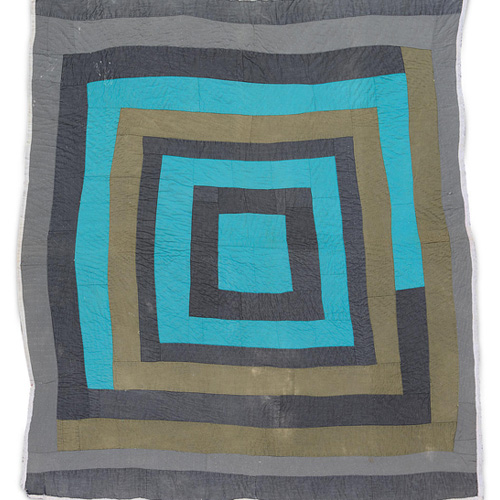
The most popular pattern in Gee’s Bend, the “Housetop," begins with a central solid medallion of cloth around which rectangular strips are joined, long end to short, creating a frame around the center motif, a square within a square. Here, Rachel Carey George quarters the squares, adding a lyrical whimsy to this otherwise traditional quilt. Made in the midst of the Great Depression, a time in history when Gee’s Bend's Wilcox County was one of the poorest in the country, the practical employment of pieces of any fabric handy becomes particularly poignant when those scraps come from empty feed sacks. Created on the cusp of Alabama's transition from a predominantly agricultural society to an industrialized one, this quilt materially and metaphorically maps the declining agricultural lifestyle of which George was once a part.
The daughter of Reverend William Carey, minister of Pleasant Grove Baptist Church, the main congregation in Gee's Bend, Rachel Carey George (1908 - 2011), was also a member of the extended family of Delia Bennett, her mother's sister. Several of her best-known quilts were made in the 1930s, during the Great Depression, when Gee’s Bend's Wilcox County was one of the poorest in the country. Quilting In this time of scarcity called for the inventive salvaging of fabric scraps and remnants, including feed sacks, which are evident in George’s quilts from this era. In Gee's Bend, this recycling practice became the founding ethos for generations of quiltmakers who have transformed otherwise useless material into marvels of textile art.
Rachel Carey George’s work is in the permanent collections of the Museum of Fine Arts, Boston, and Milwaukee Art Museum.
Learn more about Rachel Carey George here.